

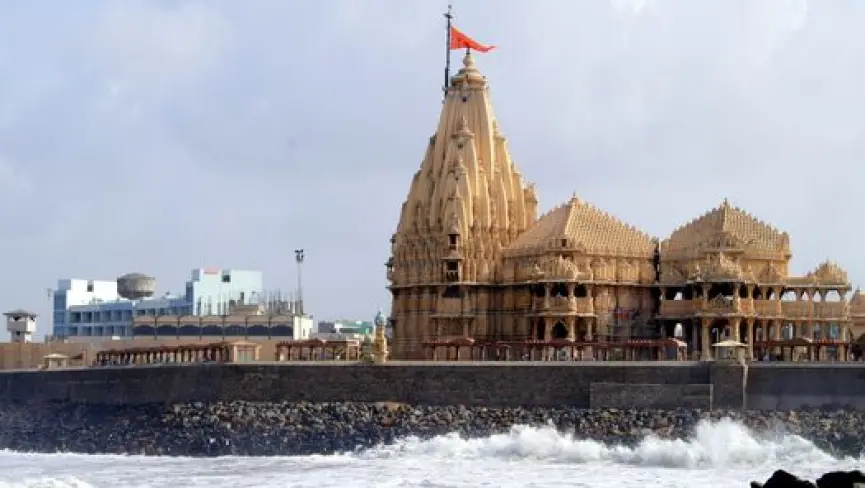
Somnath Jyotirlinga Temple: Facts, Legends & Miracles You Should Know
The Somnath Jyotirlinga Temple, located in Prabhas Patan near Veraval in Gujarat, stands as a shining symbol of spirituality, faith, and resilience. Known as the first among the 12 Jyotirlingas of Lord Shiva, this sacred shrine holds immense significance for millions of devotees.
Somnath is not just a temple — it’s a living legend that has witnessed the rise and fall of empires, invasions, and restorations, yet continues to radiate divine energy. Let’s explore the fascinating facts, legends, and miracles associated with this holy abode of Lord Somnath Mahadev.
1. Meaning and Origin of Somnath
The word “Somnath” translates to “Lord of the Moon”. According to Hindu mythology, the Moon God (Chandra Deva) lost his radiance due to a curse from Daksha Prajapati. To regain his glow, Chandra worshipped Lord Shiva at this very site, performing severe penance.
Pleased with his devotion, Lord Shiva freed him from the curse and took residence here as Somnath Jyotirlinga — symbolizing the eternal power of faith and devotion.
2. The First Among the Twelve Jyotirlingas
Somnath holds a special place in the Hindu pantheon as the first Jyotirlinga, where Lord Shiva manifested as an infinite pillar of light — the divine form of his cosmic energy. It marks the beginning of the sacred Jyotirlinga Yatra, which continues through other holy sites like Kashi Vishwanath, Rameshwaram, and Kedarnath.
Devotees believe that visiting all 12 Jyotirlingas leads to Moksha (liberation) and the fulfillment of spiritual desires.
3. The Indestructible Temple – Rebuilt Seven Times
The Somnath Temple is often called “The Temple Eternal” because of its remarkable history of destruction and reconstruction.
It was invaded and demolished multiple times by rulers such as:
-
Mahmud of Ghazni (1024 CE)
-
Alauddin Khilji (1297 CE)
-
Aurangzeb (1706 CE)
Yet, each time, the temple was rebuilt by devotees and kings, showcasing the unyielding strength of faith.
The present-day temple, constructed in 1951, was restored under the leadership of Sardar Vallabhbhai Patel and inaugurated by Dr. Rajendra Prasad, the first President of India.
4. Architectural Grandeur of Somnath Temple
The temple’s architecture follows the Chalukya style, reflecting intricate carvings and majestic design. The main Shikhara (spire) rises about 50 meters, crowned by a 10-ton Kalash (pinnacle) and a Trishul (Trident) that symbolizes the power of Lord Shiva.
A fascinating feature is the Baan Stambh (Arrow Pillar) near the sea-facing wall. An inscription on it reads:
“There is no land in a straight line between Somnath and the South Pole.”
This highlights Somnath’s unique geographical and cosmic alignment with the Earth’s axis.
5. Legends and Myths Associated with Somnath
The Legend of the Moon God (Chandra)
As mentioned in the Skanda Purana, Chandra was cursed by Daksha Prajapati to lose his luster for favoring one of his 27 wives — Rohini. Seeking redemption, Chandra performed penance here and regained his brightness, hence the temple is known as Someshwar, meaning Lord of the Moon.
Lord Krishna’s Departure from Earth
Another legend states that Lord Krishna left his mortal body at Bhalka Tirth, located close to Somnath, after being struck by a hunter’s arrow. Thus, the area holds deep connections to both Lord Shiva and Lord Vishnu, symbolizing the unity of divine energies.
6. Miracles of Somnath Jyotirlinga
Many devotees and priests have shared accounts of miraculous experiences associated with Somnath Temple:
-
Unfading Jyoti (Light): It is believed that a divine light once emitted from the original Jyotirlinga, symbolizing Lord Shiva’s cosmic presence.
-
Unharmed During Natural Calamities: Despite the proximity to the sea, the temple has remained safe from major floods and tsunamis.
-
Divine Vibrations: Visitors often feel intense spiritual energy and peace during meditation and darshan.
-
Self-Restoring Idol: Ancient texts mention that the lingam at Somnath has manifested itself repeatedly after destruction — symbolizing the immortality of faith.
Whether one believes in miracles or not, the spiritual aura of Somnath is undeniably powerful.
7. Historical Mentions in Ancient Scriptures
The glory of Somnath finds mention in numerous sacred texts, including:
-
Rig Veda – among the earliest references to Lord Shiva’s abode on the western coast.
-
Skanda Purana, Shiva Purana, and Shreemad Bhagavatam – describe the divine origin and spiritual significance of Somnath Jyotirlinga.
-
Mahabharata – mentions the region as Prabhas Kshetra, a holy land where the Pandavas and Lord Krishna performed penance.
8. Interesting Facts About Somnath Jyotirlinga Temple
-
Somnath is believed to be the spot where the Moon regained its lost light.
-
The temple’s flag is changed three times a day, each measuring 52 yards long.
-
The temple once housed a Shivling made of gold, silver, and precious stones, as mentioned in ancient texts.
-
Archaeological findings near the temple date back to the Indus Valley Civilization, proving its ancient heritage.
-
The sound of ocean waves near the temple is considered the eternal chant of “Om Namah Shivaya.”

